The Donner DDP-400 Digital Piano review is for players weighing an expressive full-size keyboard against a home-friendly upright design.
Its graded hammer action, broad practice features, and extended speaker cabinet make it suited to regular playing, while its substantial footprint and weight call for a settled place in the room.
DDP-400 Piano Review Summary
The quick verdict
700+ ratings
Read Amazon ReviewsDonner DDP-400
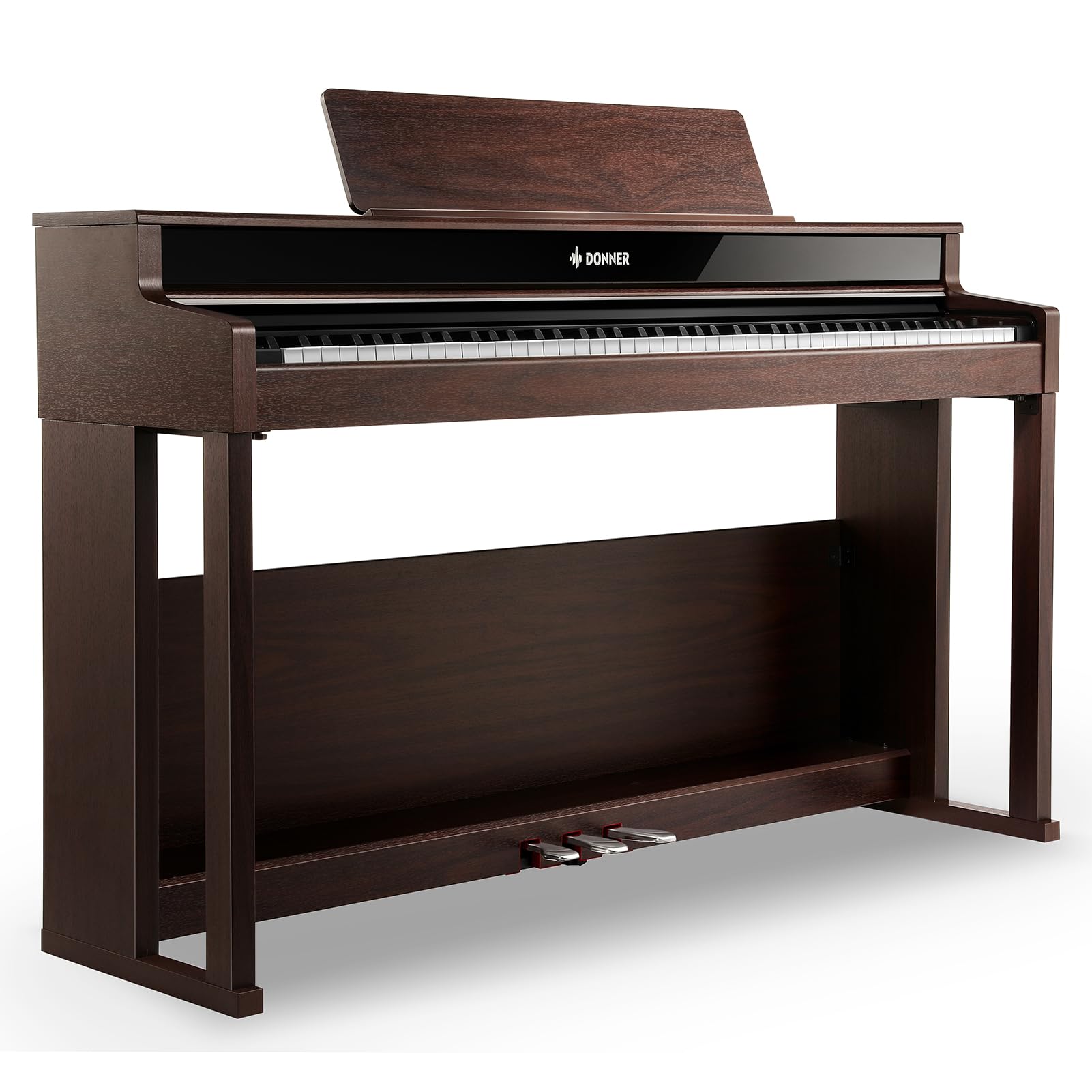
A fit for home players who want graded hammer-action keys, built-in practice material, varied tones, and a furniture-style cabinet.
- Full-size 88-key progressive weighted hammer-action keyboard with double-contact design and a heavier bass-to-lighter treble feel.
- Extended speaker cabinet designed to provide room for longer strings, a larger soundboard, richer harmonics, and stronger resonance.
- French Dream sound source with dual 15-watt amplifiers.
- Maximum polyphony of 128 notes, 138 tones, 100 rhythms, 20 demo pieces, and 100 etudes.

Pros
- Graded hammer action offers a more piano-oriented feel than an unweighted or uniformly light keyboard.
- A varied set of tones, rhythms, demos, and etudes supports both structured practice and experimentation.
Consider before buying
- At 49.54 kg, the piano is heavy to move, so plan its location before assembly or setup.
- Its 138.5 × 89 × 40 cm dimensions need more room than a compact keyboard; measure the intended spot and access route.
Read the full review summary
The DDP-400 combines an 88-key progressive weighted keyboard with a double-contact design, a French Dream sound source, dual 15-watt amplifiers, and a cabinet intended to give the speakers more room.
The graduated key resistance is designed to feel heavier in the bass and lighter in the treble, a useful layout for players who want piano-style touch across the full range.
Its 138 tones, 100 rhythms, 20 demos, and 100 etudes offer more to explore than a basic practice keyboard. App connections for iOS and Android, USB MIDI, recording, and included headphones add flexibility for lessons and quiet sessions.
At nearly 50 kg and roughly 138.5 cm wide, it makes most sense as a stationary home instrument rather than a portable keyboard.
The buying factors
DDP-400 Piano Scorecard
Editorial scores reflect listed features and buyer fit; they are not laboratory measurements or customer ratings.
Piano-style key action
Graded hammer action, double-contact design, and heavier-to-lighter key resistance are aimed at a piano-like playing response.
Sound system design
The extended speaker cabinet and dual 15-watt amplifiers support a fuller home setup, though the description gives no independent listening measurements.
Practice variety
A large selection of tones, rhythms, demos, and etudes gives players varied material for practice and exploration.
App and MIDI flexibility
iOS and Android connections plus USB MIDI support app-based lessons, recording, and music arrangement.
Quiet practice
Included headphones make late-night or private practice a straightforward part of the package.
Room placement
The upright cabinet has a home-furniture look, but its listed dimensions and nearly 50 kg weight require a dedicated space.
Key Features and Specifications of DDP-400 Piano
- Full-size 88-key progressive weighted hammer-action keyboard with double-contact design and a heavier bass-to-lighter treble feel.
- Extended speaker cabinet designed to provide room for longer strings, a larger soundboard, richer harmonics, and stronger resonance.
- French Dream sound source with dual 15-watt amplifiers.
- Maximum polyphony of 128 notes, 138 tones, 100 rhythms, 20 demo pieces, and 100 etudes.
- Chorus and mixing effects, timbre and rhythm banks, intro/outro accompaniment, and A/B interludes.
- Connections to iOS and Android devices and USB MIDI for compatible lessons, recordings, and music-arrangement workflows.
- Includes headphones; piano dimensions are 138.5 × 89 × 40 cm and listed weight is 49.54 kg.
Pros and Cons of DDP-400 Piano
Pros
- Graded hammer action offers a more piano-oriented feel than an unweighted or uniformly light keyboard.
- A varied set of tones, rhythms, demos, and etudes supports both structured practice and experimentation.
- App connections, USB MIDI, and recording support make it easier to incorporate digital lessons and music work.
- Included headphones provide an immediate option for private practice.
- The extended cabinet and warm wood styling are designed to suit a permanent place in a living space.
Consider before buying
- At 49.54 kg, the piano is heavy to move, so plan its location before assembly or setup.
- Its 138.5 × 89 × 40 cm dimensions need more room than a compact keyboard; measure the intended spot and access route.
- The feature list is extensive, so buyers who only want straightforward piano practice may have little use for many of its rhythms and accompaniment options.
Who Should Buy DDP-400 Piano?
Good fit
Consider the DDP-400 if you want a full 88-key instrument with graduated hammer action and enough onboard material to support practice beyond basic scales.
Its etudes, demos, rhythms, and tone choices create several ways to work through a session, while USB MIDI and mobile-device connections can bring lessons or music software into the routine.
It is also a reasonable fit for a household that wants an upright-style digital piano to stay set up in one place.
The included headphones add convenience for private sessions, and the cabinet is designed to contribute to the sound as well as the room's appearance. Check the dimensions and plan for help with moving it, given its listed weight.
Before choosing, decide whether you will actually use the extra accompaniment and tone features.
If regular piano practice is the main aim, the graded key response and full range are central; the remaining functions are useful extras rather than a reason to overlook placement constraints.
Who should skip it
Look elsewhere if you need a keyboard you can regularly carry between rooms, lessons, or performances. This cabinet piano is nearly 50 kg, making a permanent or mostly fixed setup the more practical plan.
It may be more instrument than you need if your priorities are minimal controls and a small footprint. Measure the room and consider whether the broad set of accompaniment and practice features matches how you play.
How the DDP-400 Piano Fits a Home Practice Setup
Graded action for piano practice
The progressive hammer-action keyboard is the DDP-400's most relevant feature for players focused on piano technique.
Its heavier low register and lighter high register are intended to reflect the changing resistance across an acoustic piano keyboard, while the double-contact design is intended to register playing more precisely.
These are design aims rather than a guarantee that every player will prefer its touch, so buyers sensitive to key feel should try it when possible.
A cabinet designed around the sound
The extended speaker cabinet is presented as a way to allow longer strings and a larger soundboard, with the goal of richer harmonics and resonance.
The dual 15-watt amplifiers provide the listed amplification, but no room coverage or measured loudness is specified.
Think of the cabinet as part of a home-focused design, and consider the room and listening level you need before relying on it for gatherings.
Practice features with room to grow
The 100 etudes and 20 demos provide built-in material, while 100 rhythms and 138 tones allow sessions to move beyond a single piano voice. Chorus and mixing effects, accompaniment controls, and A/B interludes add further options.
This range may suit curious learners and players who like structured exercises, though a buyer seeking only a simple piano sound may prefer a less feature-dense instrument.
Connections and placement
Connections to iOS and Android and USB MIDI support app-based lessons, demo recordings, and music arrangement. The included headphones help keep practice private, but the cabinet's dimensions and weight make placement a practical decision rather than an afterthought.
Check the available floor area, route into the room, and whether you expect to keep the piano in one spot.
Alternatives to DDP-400 Piano
Home Digital Pianos alternative
200+ ratings
Read Amazon ReviewsDonner DDP-200
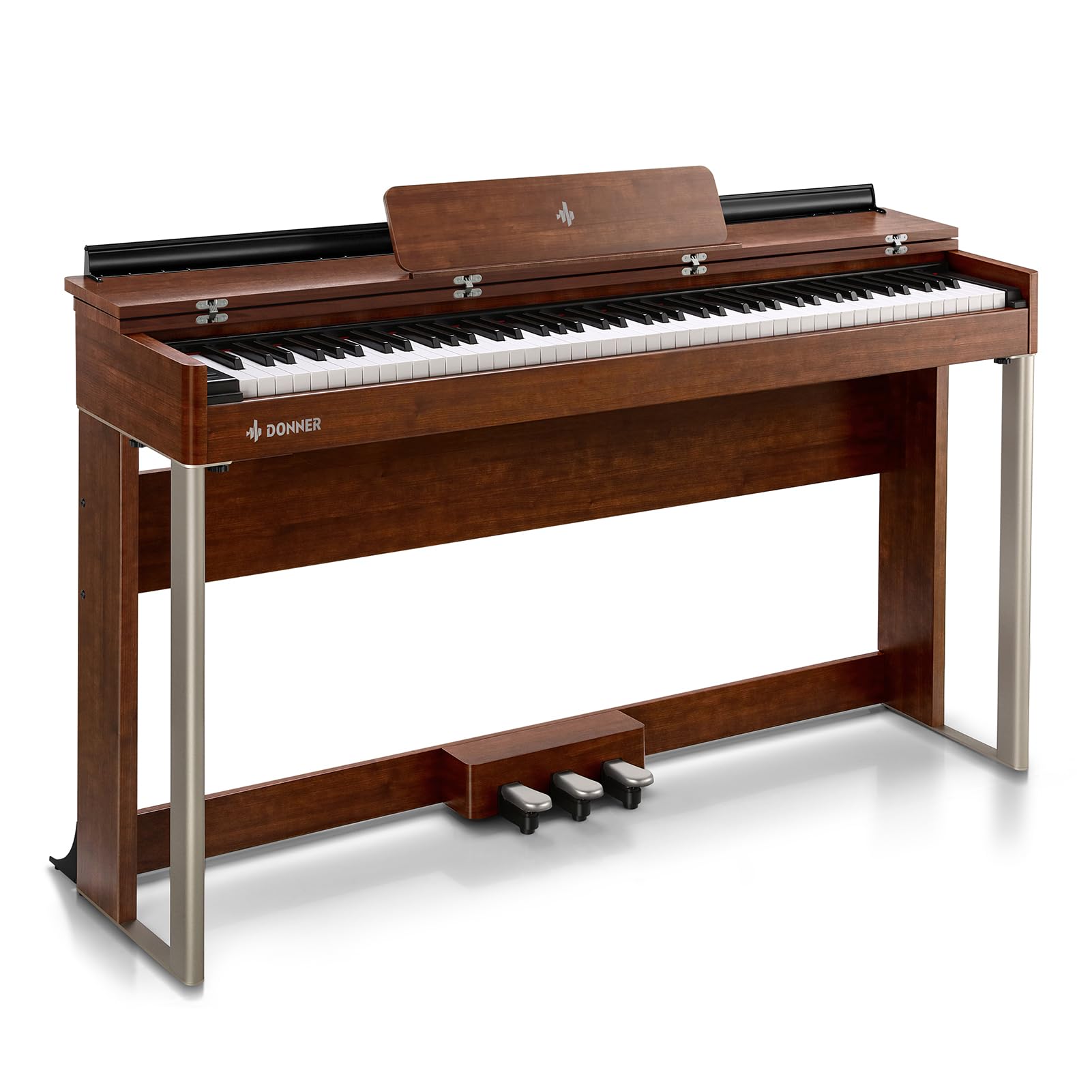
Choose the DDP-400 if its larger practice library and extended cabinet are the priority. The DDP-200 is worth comparing if a triple pedal, Bluetooth MIDI, or a screen for tone and effect selection better matches your setup.
- The DDP-200 has graded hammer action, a triple pedal, Bluetooth MIDI, an LCD screen, and five reverb effects.
- The DDP-400 pairs progressive weighted keys with 138 tones, 100 rhythms, 20 demos, 100 etudes, and an extended speaker cabinet.
Home Digital Pianos alternative
1,000+ ratings
Read Amazon ReviewsDonner DDP-80
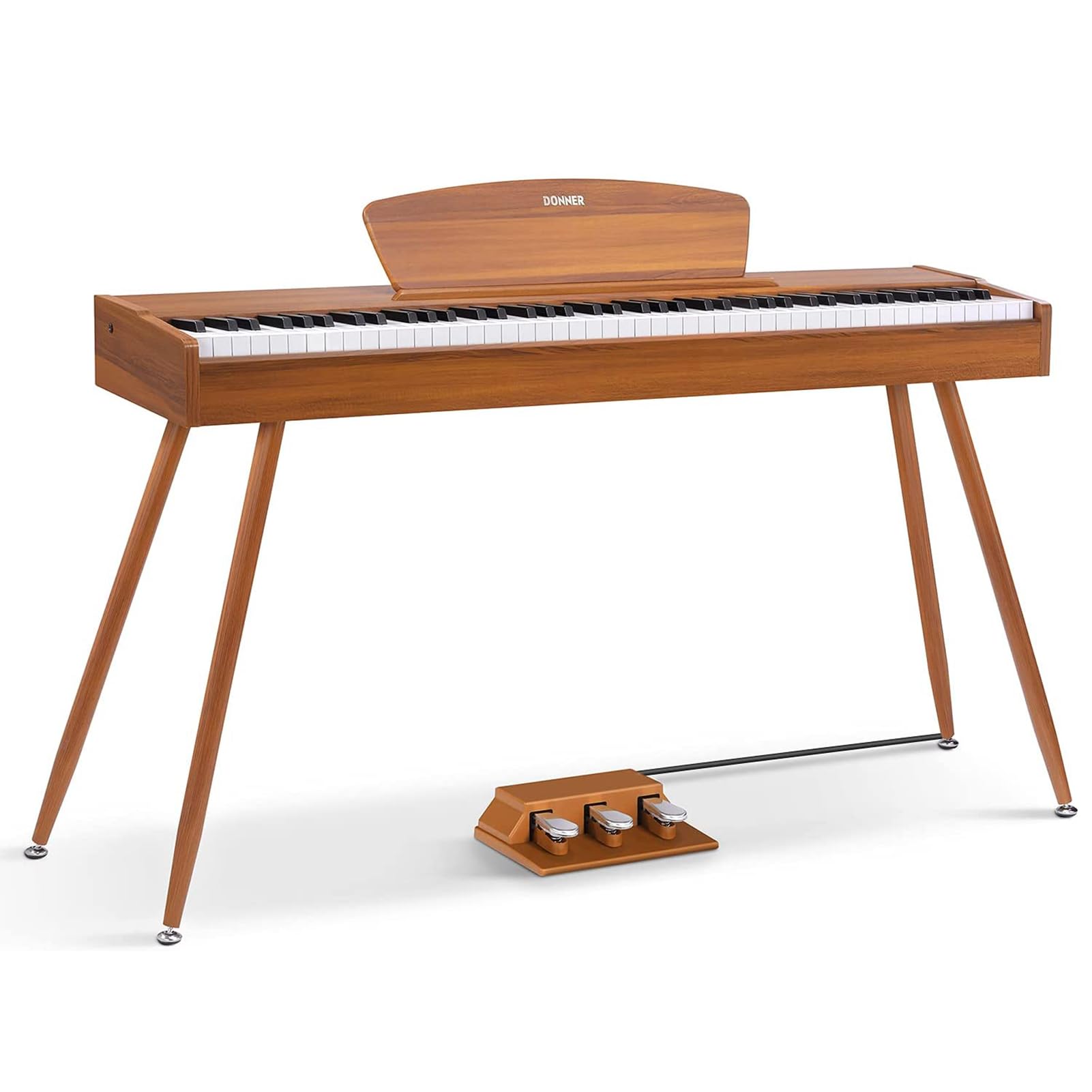
The DDP-80 may suit buyers who prefer a simpler feature set with a triple pedal and USB MIDI. The DDP-400 gives more listed tones, rhythms, and practice material, so compare those features against the pedal configuration you want.
- The DDP-80 offers weighted hammer-action keys, 128-note polyphony, three pedals, USB MIDI, app compatibility, and two stereo speakers rated at a maximum of 25 watts each.
- The DDP-400 emphasizes graded key resistance, a broad set of rhythms and etudes, mobile-device connections, and an extended speaker cabinet.
Is DDP-400 Piano Worth It?
The Donner DDP-400 is worth considering for home players who want a full-size, graded hammer-action keyboard with plenty of built-in practice and sound options.
Its app and USB MIDI connections and included headphones broaden how it can fit into lessons and private playing.
Its strongest case is a stationary practice setup where the cabinet can remain in place and the extra features will see regular use.
Measure first and plan for moving a 49.54 kg instrument; if portability or simplicity matters more, compare a less feature-heavy design.
Your review at a glance
700+ ratings
Read Amazon ReviewsDonner DDP-400
A fit for home players who want graded hammer-action keys, built-in practice material, varied tones, and a furniture-style cabinet.
- Full-size 88-key progressive weighted hammer-action keyboard with double-contact design and a heavier bass-to-lighter treble feel.
- Extended speaker cabinet designed to provide room for longer strings, a larger soundboard, richer harmonics, and stronger resonance.
- French Dream sound source with dual 15-watt amplifiers.
- Maximum polyphony of 128 notes, 138 tones, 100 rhythms, 20 demo pieces, and 100 etudes.